Loading...
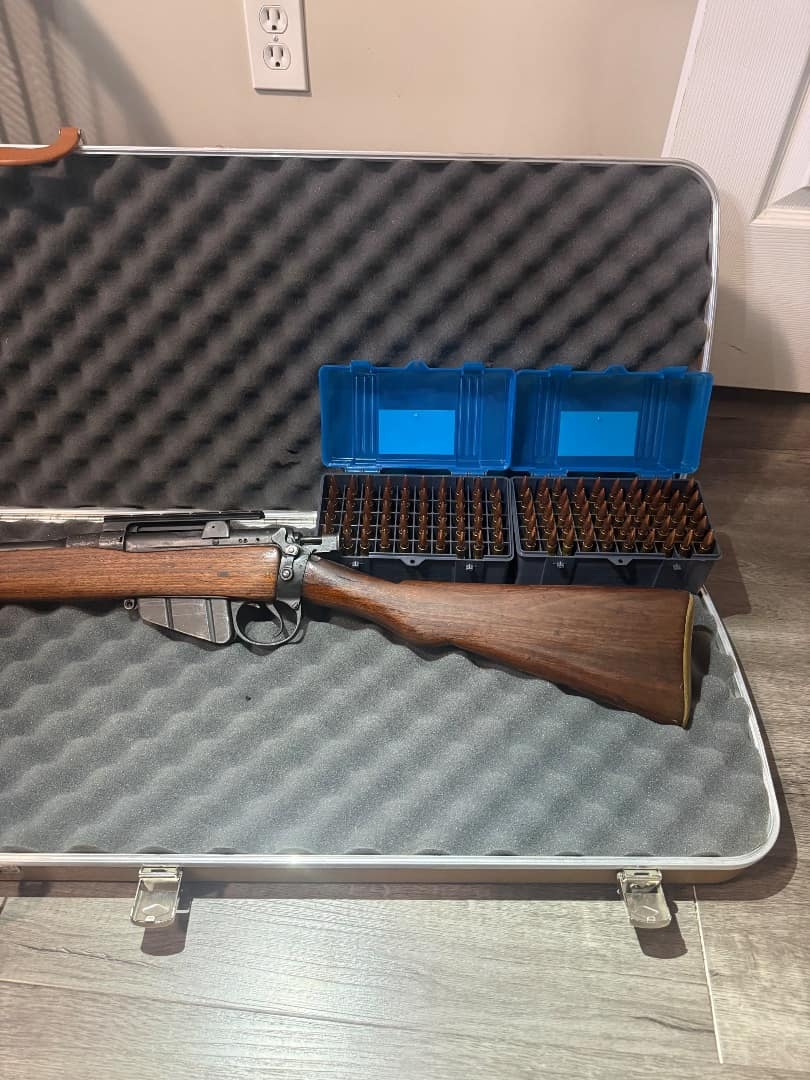
Photo of Lee Enfield No: 1 Mark III 1938 GR1 Singapore SMTLE
$1450
Lee Enfield No: 1 Mark III 1938 GR1 Singapore SMTLE
Lee Enfield No: 1 Mark III 1938 GR1 Singapore SMTLE . 303 BRITISH 10 round Mag, full wood, swivels, bayonet lug with pig sticker bayonet included, rear brass butt plate with tool kit compartment, 2000m rear adjustable iron sight. Frame and butt stock medallion match. Mag number unreadable. Length: SMLE No. 1 Mk III: 44.57 in (1,132 mm) Barrel length: SMLE No. 1 Mk III: 25.2 in (640 mm) In late 1915 the Mk III* was introduced incorporating several changes, the most prominent of which were the deletion of the magazine cut-off mechanism, which when engaged permits the feeding and extraction of single cartridges only while keeping the cartridges in the magazine in reserve, and the long-range volley sights. The windage adjustment of the rear sight was also dispensed with, and the cocking piece was changed from a round knob to a serrated slab. Rifles with some or all of these features present are found, as the changes were implemented at different times in different factories and as stocks of parts were depleted. The magazine cut-off was reinstated after the First World War ended, and not entirely dispensed with in manufacturing until 1933. The SMLE Mk III* (renamed Rifle No.1 Mk III* in 1926) saw extensive service throughout the Second World War, especially in the North African, Italian, Pacific and Burmese theatres in the hands of British and Commonwealth forces. Australia and India retained and manufactured the SMLE Mk III* as their standard rifle during the conflict, and the rifle remained in Australian military service through the Korean War, until it was replaced by the L1A1 SLR in the late 1950s.The Lithgow Small Arms Factory finally ceased production of the SMLE Mk III* in 1953.
categories:Sporting GoodsGuns
46822 impressions
1870 views
Saskatoon, SK6 days ago
Photo of WWII-era British military commando Wrist Compass
$345
WWII-era British military commando Wrist Compass
This is a WWII-era British military wrist compass (officially designated “Compass, Survival, Wrist Type,” Air Ministry Ref. No. 6B/2593), issued primarily to RAF aircrew (pilots and navigators) as part of escape and evasion/survival kits, but also widely used by British airborne forces, paratroopers, SAS, SOE, and commandos. Key Features •  Blackened metal case (brass or steel) with a hinged hunter-style lid containing a mirror (for signaling). •  Dry-card design (non-liquid/air-damped compass card – no fluid visible, with a floating card that settles more slowly than liquid-filled types). The central thumb screw rotates the bezel for sighting/bearings. •  Luminous markings (originally radium paint for night visibility). •  Long khaki herringbone twill webbing strap (designed to wear over flying suits, sleeves, thigh, or ankle). •  Back markings: REF No. 6B/2593 (or similar worn variant like N968/2593), SER No. in “B/” format (B often denoting manufacturer Francis Barker & Son). Close-up photo clearly shows the dry floating card (white/silver with black markings, no damping fluid or bubbles), distinguishing it from the more common liquid-filled variants of the same model. These were produced from the early 1940s through the post-war period (your serial/year code suggests 1950s–1960s production). Dry versions are authentic but less frequently encountered intact, as many liquid ones leaked over time. Can can ship anywhere, Please see my other ads for rare and collectable military items
categories:Sporting GoodsCamping and Survival Gear
2958 impressions
331 views
Chestermere, AB6 days ago
Photo of WW2 1940 Original Canadian WWII P37 canvas holster
$80.00
WW2 1940 Original Canadian WWII P37 canvas holster
Here is a Canadian/British origin and the C broad arrow marking), and cross-referencing the images (including the faint stamping that reads “Z.L.&T. LTD 1940” along with the C broad arrow symbol), this is an original Canadian WWII Pattern 1937 (P37) web pistol holster. Features •  Khaki/tan heavy cotton canvas construction, typical of British/Commonwealth web gear from the era to save on leather due to wartime shortages. •  Flap closure with brass snap (often called a “lift-the-dot” fastener in some variants). •  Brass or metal belt hanger and loops on the back for attachment to P37 web belts or pistol belts. •  Angled design for right-side hip carry, with a reinforced muzzle end. •  Markings: “Z.L.&T. LTD 1940” refers to the manufacturer Zephyr Looms & Textiles Ltd. (Toronto, Canada), a known WWII contractor for Canadian military gear. The “C broad arrow” (often stylized as C↑ or C with an arrow inside) is the Canadian government property/acceptance mark, indicating it was issued for Canadian forces (part of the British Commonwealth system, where the broad arrow denotes ordnance property, and the “C” specifies Canada). This holster was designed primarily for revolvers like the Webley Mk IV .455 or Enfield No. 2 .38, which were standard for Canadian troops early in WWII. However, similar P37 holsters were also used or adapted for the Canadian-made Inglis Browning Hi-Power 9mm pistol (produced from 1944 onward). Original Canadian WWII P37 canvas holsters in good used condition (like this one, with intact hardware and no major tears) typically sell for $150–$350 on sites like eBay, GunsInternational, or militaria forums/auctions. Factors influencing price include: Rarity of the early 1940 date (pre-U.S. entry into the war, during the British Commonwealth’s initial buildup). Clear markings (the C broad arrow and manufacturer stamp add provenance). Condition: This appears solid but field-used, so more toward the $200–$300 range. Recent comparable sales include similar Z.L.&T. Ltd.-made holsters from 1943–1945 fetching $200–$300. Can ship anywhere in Canada Please see my other ads for collectable military accessories.
categories:Sporting GoodsGuns
17720 impressions
341 views
Chestermere, AB6 days ago
Photo of WW2 1943 Canadian/British holster
$95
WW2 1943 Canadian/British holster
Here is a Canadian/British origin and the C broad arrow marking), and cross-referencing the images (including the faint stamping that reads “Z.L.&T. LTD 1943” along with the C broad arrow symbol), this is an original Canadian WWII Pattern 1937 (P37) web pistol holster. Features •  Khaki/tan heavy cotton canvas construction, typical of British/Commonwealth web gear from the era to save on leather due to wartime shortages. •  Flap closure with brass snap (often called a “lift-the-dot” fastener in some variants). •  Brass or metal belt hanger and loops on the back for attachment to P37 web belts or pistol belts. •  Angled design for right-side hip carry, with a reinforced muzzle end. •  Markings: “Z.L.&T. LTD 1943” refers to the manufacturer Zephyr Looms & Textiles Ltd. (Toronto, Canada), a known WWII contractor for Canadian military gear. The “C broad arrow” (often stylized as C↑ or C with an arrow inside) is the Canadian government property/acceptance mark, indicating it was issued for Canadian forces (part of the British Commonwealth system, where the broad arrow denotes ordnance property, and the “C” specifies Canada). This holster was designed primarily for revolvers like the Webley Mk IV .455 or Enfield No. 2 .38, which were standard for Canadian troops early in WWII. However, similar P37 holsters were also used or adapted for the Canadian-made Inglis Browning Hi-Power 9mm pistol (produced from 1944 onward). Original Canadian WWII P37 canvas holsters in good used condition (like this one, with intact hardware and no major tears) typically sell for $150–$350 on sites like eBay, GunsInternational, or militaria forums/auctions. Factors influencing price include: Invasion date1943 date (pre-U.S. entry into the war, during the British Commonwealth’s initial buildup). Clear markings (the C broad arrow and manufacturer stamp add provenance). Condition: This appears solid but field-used, so more toward the $200–$300 range. Recent comparable sales include similar Z.L.&T. Ltd.-made holsters from 1943–1945 fetching $200–$300. Can ship anywhere in Canada Please see my other ads for collectable military accessories.
categories:Sporting Goods
3880 impressions
186 views
Chestermere, AB6 days ago
Showing 21 of 759 records
Location
Search within
of
Categories

Other2

Medical Equipment

Transportation options

Local Pickup675Can Deliver58Can Ship299