expoantique
Last seen 3d ago
Marieville, Quebec
Joined 9 months agoMarieville, Quebec
Joined 9 months ago| Photo | Title | Price | Posted |
|---|---|---|---|
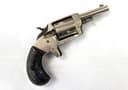 | Authentic RF Defender 89 pistol The Defender 89 was manufactured by Iver Johnson, Worcester, MA, in the late 1800s. This Defender 89 is chambered in .32 rimfire. The 2 3/8" round barrel has a very good bore with glazing in the rifling grooves. The top sling is marked DEFENDER 89. The pistol retains approximately 95% of its original nickel-plated finish with some scattered flaking. The very thin, hard rubber grips have decorative rollers with "DEFENDER '89" on each side. There are no cracks or chips. The action functions correctly. It's a good example of the type of pistol carried by most people in the late 19th century. Category: HISTORICAL WEAPON. Requires no permit or registration. | $1250 | Aug 4, 2026 |
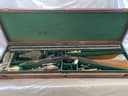 | Exceptional Double-Barreled Shotgun Set in Original Presentation Case Rare and impressive antique double-barreled shotgun set offered in its original fitted wooden presentation case. This beautiful collector's piece includes the shotgun, accessories, tools, powder flask, ramrod, and various original components carefully fitted inside a green felt-lined case. Features: • Elegant side-by-side double-barrel shotgun • Original wooden presentation/storage case • Complete assortment of period accessories and tools • Attractive walnut stock with fine checkering • Excellent display piece for collectors of antique firearms and sporting memorabilia • Rich patina and authentic period character A remarkable addition to any antique firearm collection, museum display, or historical sporting collection. Condition: Good antique condition with age-related wear consistent with its vintage. Sold as a collectible item. Buyers are responsible for ensuring compliance with all applicable laws and regulations. https://www.expoantique.net/en/product-page/exceptionnel-coffret-fusil-de-chasse-à-double-canon | $8500 | Aug 4, 2026 |
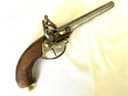 | Authentic flintlock pistol, Model 1777, 2nd type, France, Louis XVI period Flintlock pistol, model 1777, 2nd type, France, Louis XVI period. Steel, brass, wood. Long. total: 33; Long. barrel: 19.2 cm Cal. : 17.1mm Six-sided barrel at the breech, then round and smoothbore, numbered "18". Flintlock mechanism. Brass receiver, engraved "Maubeuge" and marked with a crowned "A" for the finished arms inspector Alexandre, who served from 1782 to 1792. Brass furniture. Walnut stock. Inspection marks. During the period of manufacture of the 1777 model, the control personnel of the Maubeuge factory were for the inspector: De Villiers (1781-1787) and Lefevre de Grivy (1787-1791), for the finished weapon controller: Cousin (1753-1782) and Alexandre (1782-1792), for the lock controller: Alexandre (1778-…) and Leroy (1779-1792), for the barrel inspector: Desnays (1777-1782) and May (1782-1792). https://www.expoantique.net/en/product-page/description-à-venir | $2400 | Aug 4, 2026 |
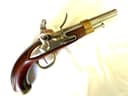 | Authentic McCampbell flintlock pistol – 1813 McCampbell Flintlock Pistol – 1813 Model: Cavalry or belt flintlock pistol Manufacturer: McCampbell (gunsmith identified by the signature on the lock plate) Date: 1813 (date visible on the barrel) Probable origin: British Isles (Scotland or England) Type: Single-shot, muzzle-loading firearm Ignition system: Flintlock This flintlock pistol is a remarkable example of Napoleonic-era weaponry. Made in 1813, it features a walnut stock, an octagonal then cylindrical steel barrel, and brass fittings including the trigger guard, muzzle cap, and buttplate. The lock plate is signed "McCampbell," indicating a gunsmith of British tradition. The flintlock mechanism is complete and retains its original design. The metal loading rod is also present, an element often missing on surviving examples. Historical Context: The year 1813 corresponds to the final period of the Napoleonic Wars. Pistols of this type were commonly issued to: • cavalrymen and officers; • local militias; • merchants and travelers; • naval officers. Before the arrival of percussion systems in the 1820s-1840s, the flintlock mechanism was the dominant technology in European armies. Condition of preservation The weapon appears in a condition above average: • complete mechanism; • legible manufacturer's signature; • clearly visible date; • wood with little alteration; • intact brass fittings; • loading rod present. https://www.expoantique.net/en/product-page/description-à-venir-1 | $2800 | Aug 4, 2026 |
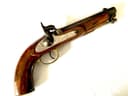 | Authentic percussion pistol – 19th century (c. 1835–1860) Antique percussion pistol, single shot, dating from the mid-19th century, of European manufacture (France). Description • System: Percussion • Caliber: Probably .36 to .45 (smoothbore) • Barrel: Steel, unrifled • Lock: Side-action, percussion, with period markings/proofs (partially legible) • Stock: Walnut, original patina • Furniture: Brass • Brass trigger and trigger guard • Civilian firearm of the travel/belt pistol type • Handmade or semi-industrially produced, not an official military model Condition • Very good condition for its age • Even patina, normal wear from use • Sound wood, no major cracks • Mechanism appears functional (to be confirmed by the buyer) • No apparent modern restoration Interest • Beautiful collector's item • Representative of 19th-century civilian firearms • Ideal for collectors, historical decor, or reenactment Legal • Antique firearm (pre-1898) • Classified as non-restricted in Canada according to current regulations • Sale in accordance with Canadian law | $1730 | Aug 4, 2026 |
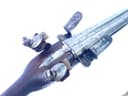 | RARE – Exceptional Saint-Étienne Style Double-Barrel Flintlock Musket | International Black Powder Competition Provenance Outstanding French Saint-Étienne style double-barrel flintlock musket featuring an impressive long-barrel configuration and twin flintlock ignition system. This remarkable firearm showcases side-by-side barrels, dual flintlock mechanisms, and a beautifully aged hardwood stock with exceptional period character. The metal components display an authentic historical patina consistent with a well-preserved antique firearm. This musket was also used in international black powder shooting competitions, adding a unique sporting heritage to its historical appeal. Highlights • Authentic double-barrel flintlock configuration • Saint-Étienne style French manufacture • Exceptional collector presentation • Attractive aged hardwood stock • Twin flintlock mechanisms • Previously used in international black powder shooting competitions • Ideal for collectors, historical displays, museums, or black powder enthusiasts Historical Significance Saint-Étienne has been one of France's most important firearms manufacturing centers for centuries. Flintlock firearms represent a major milestone in firearms development and remain highly desirable among collectors of early military and sporting arms. Double-barrel flintlock firearms are particularly sought after due to their mechanical complexity and relative rarity compared to standard single-barrel examples. Condition • Very attractive overall appearance • Solid antique wood stock • Genuine aged metal patina • Sold as a collectible historical firearm Serious inquiries only. https://www.expoantique.net/en/product-page/rare-impressionnant-fusil-à-silex-double-canon-de-style-saint-étienne-ancien | $2800 | Aug 13, 2026 |
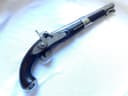 | Authentic military flintlock pistol, converted to percussion Military flintlock pistol, converted to percussion Typology Handgun – military pistol Attributed to a European military production of British type (naval or colonial use) Place of manufacture (probable) Great Britain or British sphere of influence Dating • Original manufacturing process (flint): around 1760–1790 (second half of the 18th century) • Percussion conversion: around 1825–1850 (first half of the 19th century) Material description A long, smoothbore pistol mounted on a strongly curved wooden stock ending in a metal pommel. Iron furniture, side lanyard ring. General Architecture characteristic of 18th century military pistols intended for naval or service use. The weapon features a percussion mechanism, resulting from a subsequent conversion: replacement of the hammer, removal of the old pan and adaptation of the firing mechanism, according to a common practice aimed at extending the service life of flintlock weapons 19th century. Historical context This pistol illustrates the longevity and adaptability of old military weaponry. Originally designed during the colonial conflicts of the late 19th century... In the 18th century, it was modernized with the introduction of percussion, a major innovation that improved the reliability of firearms. Such conversions were frequent in military, maritime and colonial circles, particularly in North America. https://www.expoantique.net/en/product-page/authentique-pistolet-description-à-venir | $2100 | Aug 4, 2026 |
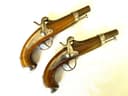 | Authentic pair of French cavalry pistols, 19th century Percussion cavalry pistol (originally flintlock, later modified) • Solid walnut stock, strongly curved with metal butt cap • Short, large-caliber barrel with metal ramrod • Locking mechanism typical of French military weapons • Presence of a percussion system (hammer striking a nipple) French cavalry pistol, model 1816/1822, converted to percussion (known as a “T”). This type of weapon is common in the evolution of French regulations: • initially manufactured with flintlock in the early 19th century • then converted to percussion around 1835–1855. Period • Original manufacture: early 19th century (c. 1810–1825) • Conversion to percussion: mid-19th century (c. 1840) This perfectly reflects the technological transition from flintlock to percussion, a key stage in the history of firearms. Technical description • Type: Military handgun (cavalry) • System: Percussion (later modification) • Loading: Muzzle-loading • Estimated caliber: 18 mm (French military standard) • Materials: • Walnut stock • Steel furniture • Smoothbore barrel • Accessories: Metal cleaning rod (present) The configuration and proportions correspond to the standard French pistols used in the Napoleonic campaigns and later under the July Monarchy and the Second Empire. Historical context: French cavalry pistols: • dominated individual military weaponry between the 18th and mid-19th centuries • were carried in pairs in saddlebags • were progressively modernized with the advent of percussion, a more reliable system than flintlock. The modified Model 1822 is emblematic of this technological transition. Condition • Good overall condition • Consistent patina • Markings present (proof mark visible on barrel) • Homogeneous pieces (no major anomalies visible) Strengths: • Representative of French military weaponry • Concrete evidence of the technical transition from flintlock to percussion caps • Ideal educational tool (evolution of firing mechanisms) • Similar weapons are present in national collections (Type Mle 1822) Relevance to collection: • Completes a Napoleon/19th century section • Good value for money for an institutional acquisition • Robust, visually evocative object Conclusion – Acquisition Rationale This pistol is a typical and relevant piece of French military heritage. Its conversion to percussion makes it an excellent example of the army's adaptation to 19th-century technological innovation. Cavalry pistols were historically carried in pairs in saddle holsters. • A preserved pair indicates: • greater historical integrity • less dispersal over time • Collectors and institutions strongly seek complete sets https://www.expoantique.net/en/product-page/authentique-paire-de-pistolets-de-la-cavalerie-française-19e-siècle | $4400 | Aug 4, 2026 |
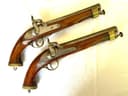 | Authentic pair of French cavalry pistols, 19th century British East India Company pistol, United Kingdom, 19th century Steel, brass, wood Long. total: 40; Long. barrel: 23 cm Cal. : 17mm Round barrels monogrammed respectively "IN" and "TV". Iron ramrods with nail heads, mounted on a swung stirrup, convex. Flat-bodied lock plates, one stamped with a rampart lion. Chiseled hammers and checkered ridges. Wooden stock with a long fore-end. Brass furniture. Flat brass butt caps with a suspension ring. Percussion system. Available as a pair. | $4200 | Aug 4, 2026 |
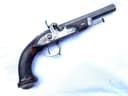 | Authentic Saint-Etienne competition pistol Authentic Saint-Etienne competition pistol, France 19th century This pistol was used in international shooting competitions. Steel, wood, silver, brass Overall length: 33 cm - Barrel length: 18.7 cm 17 mm cal. Octagonal barrel, smoothbore, polished white; half-moon front sight. Breech tang with V-notch rear sight and guilloché screw. Fine engravings on all metal components. Dog with a crest and guilloché screw. Chimney mounted on a base attached to the cylinder head with a fire screen. All iron fittings. Walnut mount, short shaft, checkered grip, carved padded pommel. Oval cap nail. Silver-plated shoot piece and rosettes. Nail-headed stick Very good condition. https://www.expoantique.net/en/product-page/authentique-pistolet-saint-etienne-de-compétition | $2400 | Aug 13, 2026 |
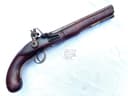 | Exceptional English percussion pistol signed George Jones, England Exceptional English percussion pistol signed George Jones - England, circa 1835–1855 Rare and authentic percussion belt pistol, of English manufacture, signed GEO. JONES, a renowned gunsmith active in England during the first half of the 19th century. This civilian self-defense pistol perfectly illustrates the quality and elegance of English gunmaking in the early Victorian era. Designed for discreet carry while traveling, it is distinguished by its meticulous craftsmanship, balanced proportions, and a finish clearly superior to contemporary continental productions. • System: percussion, single-shot • Manufacturer: George Jones (England) • Period: c. 1835–1855 • Barrel: smoothbore, octagonal at the breech then round, with original patina • Turntable: percussion, finely adjusted, signed GEO. JONES • Frame: antique walnut, rich patina, excellent wood/metal fit • Fittings: brass (bridge, mouthpiece) • Original use: travel/belt pistol (civilian weapon) State Very good state of preservation for a weapon that is almost two centuries old. • Homogeneous and authentic patina • Sound wood, without structural cracks • Mechanism in apparent good condition • No visible modern restoration Interest for the collector • A signed weapon, which is increasingly sought after • High-quality English manufacturing, superior to Belgian mass production • A representative piece of 19th-century British civil self-defense • Suitable for both specialist collections and high-end museum displays or historical decor Legal status (Canada) • Antique percussion weapon, manufactured before 1898 • Classified as non-restricted under current Canadian legislation https://www.expoantique.net/en/product-page/exceptionnel-pistolet-anglais-à-percussion-signé-george-jones-angleterre-vers-1 | $1800 | Aug 4, 2026 |
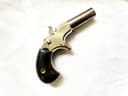 | Authentic Remington single-shot pocket pistol, 1840 A pocket pistol representative of American production in the second half of the 19th century. The overall condition shows normal wear and tear, with no apparent structural damage. Estimate based on visual analysis and comparable market examples. • Caliber: .41 Short Rimfire • Capacity: 1 shot • Barrel length: approx. 63 mm (≈ 2½ in) • Period of manufacture: approx. 1863–1888 • Type: tilting derringer, percussion cylinder • Manufacturer: Remington Arms Co. • Model: Remington-Elliot Derringer (often called Remington Model 95, early single-shot Elliot pattern) • Caliber: .41 Short Rimfire • Capacity: 1 shot • Barrel length: approx. 63 mm (≈ 2½ in) • Production period: approx. 1863–1888 • Type: break-action derringer, rimfire • Interest: historical and collectible Condition as seen in photos Positive points: • Visually complete mechanism • Well-fitted barrel and frame (no apparent deformation) • Well-preserved gutta-percha or hardwood grips • Serial number partially legible on the barrel • Mostly sound metal, no visible deep corrosion Rarity and demand: • Remington-Elliot pistols are: • more sought after than generic pocket pistols, • associated with a major manufacturer, • well-documented historically. • The .41 RF caliber is also obsolete, but less of a problem here given the collector's interest. https://www.expoantique.net/en/product-page/authentique-pistolet-de-poche-remington-mono-coup-1840 | $1800 | Aug 4, 2026 |
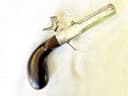 | Authentic small French pocket pistol, 19th century Antique collectible percussion (caplock), single-shot, pocket pistol type, typical of European civilian weapons from the mid-19th century, intended for discreet self-defense. Identification • Type: percussion pocket pistol • System: percussion cap • Capacity: 1 shot • Operation: simple action • Probable origin: Europe (Belgium / France / England) • Period: c. 1840–1860 Description • Barrel: steel, smoothbore, cylindrical • Platinum: steel, period decorative engraving (floral motifs) • Dog: external • Trigger: folding (folding trigger) • Handle: antique wood, rounded baguette shape • Finish: homogeneous antique patina, unrestored State • Overall condition: good for a weapon of this period • Metal: natural patina, normal superficial pitting • Wood: sound, without structural cracks • Mechanics: complete (functioning not guaranteed, collector's item) Interest for collectors • A genuine pre-cartridge weapon • Beautiful decorative engraving, uncommon on utility models • Highly sought-after compact format • Perfect for collecting 19th-century civilian weapons or percussion weapons Legal notices • Weapon predating 1898 • Antique collectible weapon • Not intended for shooting • Regulations vary depending on the jurisdiction https://www.expoantique.net/en/product-page/authentique-petit-pistolet-de-poche-français-19e-siècle | $500 | Aug 4, 2026 |
 | Authentic Remington Elliot Deringer pistol - Perper Box RARE PEPPER BOX PISTOL (PEPER BOX) REMINGTON ELLIOT DERINGER. Ca 1880. Four-barreled, fixed-barrel pistol in .32 caliber with a 9 cm rim. Impeccable patina. Bright bores with excellent rifling. Ignition is achieved by means of a rotating firing pin that strikes the cartridges one after the other. The barrel is stamped on the left side: Manufactured by E. REMINGTON & SONS. ILLION, NY. And on the right side: ELLIOTS PATENTS. MAY 29, 1850 - OCT 1862. Steel frame. The unusual trigger is ring-shaped. Ebonite grips in perfect condition. No license. | $2480 | Aug 4, 2026 |
 | Authentic Remington Derringer M95 - .41 RF. Very Good Condition Model: M95 Derringer Caliber: .41 RF Condition: Very good condition / Used Operation: Double action / Single action Capacity: 2 shots (tilt-barrel) Finish: Chrome Magnificent M95 Derringer, ideal for collectors. Very robust weapon with high-quality wooden grip panels. Perfect mechanism. There are a few small pits in some places, but nothing to detract from its value and beauty! Sold with a presentation box. Historic category weapon in Canada. No permit is required to purchase it. Sale only to adults. | $3200 | Aug 4, 2026 |
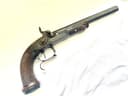 | Antique Coutollau Dueling Pistol – Exceptional Collector's Piece Beautiful antique Coutollau dueling pistol, crafted by the renowned French gunsmith of the 19th century. This elegant percussion pistol features an octagonal barrel, finely engraved lockplate, and a beautifully aged walnut grip with rich patina. A standout feature is the finely sculpted pommel cap, demonstrating the remarkable craftsmanship typical of high-quality French dueling pistols of the period. The COUTOLLAU maker's mark is clearly visible on the lockplate. Features: • Maker: Coutollau (France) • Antique percussion dueling pistol • Octagonal barrel • Original engraved metalwork • Walnut grip with attractive aged finish • Historic and highly collectible piece Condition: Very good antique condition with age-appropriate wear. Mechanical condition should be evaluated by the buyer. Perfect for: • Antique firearms collectors • Military history enthusiasts • Museums and historical displays • High-end historical décor collections Sold as a collectible antique. Buyer is responsible for compliance with all applicable laws and regulations. https://www.expoantique.net/en/product-page/exceptionnel-pistolet-de-duel-coutollau | $5130 | Aug 4, 2026 |
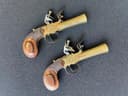 | Authentic pair of French naval officer's pistols, 18th century Queen Anne type flintlock pocket pistol Type: Single-shot personal defense weapon Origin: Great Britain Period: Late 18th century – early 19th century (circa 1770-1820) Materials: Brass, steel, and precious wood inlaid with wire Caliber: Undetermined Ignition system: Flintlock This flintlock pocket pistol belongs to the family of personal defense weapons known as the "Queen Anne." Its flared brass barrel, compact mechanism, and rounded butt grip were designed for discreet carry in a pocket or travel bag. The weapon features Georgian-style engraved decoration, including a radiating rosette on the top of the frame and finely chased ornamental panels. The checkered wooden grip is enhanced with an oval metal inlay, indicating careful craftsmanship intended for a wealthy clientele. Historical Context In the 18th century, travelers, merchants, and officers frequently carried small pocket pistols for personal protection. Lighter and more discreet than military pistols, these models were particularly popular in towns and on trade routes. The invention of percussion ignition in the early 19th century gradually led to the abandonment of flintlock weapons, making this example a testament to the last generation of handguns before the major industrial innovations of the Victorian era. Condition The weapon retains much of its original finish. The brass barrel remains well preserved, and the decorative elements are still clearly visible. The stock shows little alteration and retains its metal inlay. Collector's interest: This piece illustrates the evolution of civilian defense weapons at the end of the Georgian period and is an excellent example of the craftsmanship of gunsmiths specializing in luxury pocket weapons intended for the bourgeoisie and travelers of the 18th and 19th centuries. https://www.expoantique.net/en/product-page/paire-de-pistolets-d-officier-de-la-marine-française-18e-siècle | $3800 | Aug 4, 2026 |
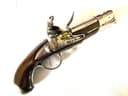 | Authentic French military flintlock pistol, Model 1822 Saint-Étienne An exceptional, unmodified French military flintlock pistol, model 1822 (first type), manufactured at the Saint-Étienne Arms Factory. This weapon represents the ultimate development of the flintlock system in French military weaponry. Description: Adopted in 1822, this model was intended for mounted troops, cavalry, and certain military services, before being gradually replaced or converted to percussion. Examples that remained flintlock are now significantly rarer, the majority having been modified in subsequent decades. • System: Flintlock, single-shot • Model: 1822 (original manufacture, unmodified) • Manufacturer: Saint-Étienne Arms Factory • Period: c. 1822–1835 • Barrel: Smoothbore, steel, regulation patina • Lock: Regulation French flintlock, marked St-Étienne • Stock: Antique walnut, regulation profile • Furniture: Brass (trigger guard, butt plate) • Operation: Functional mechanism Condition: Very good condition for a military weapon over 200 years old. • Complete and functional flintlock mechanism • Even, aged patina • Sound wood, without structural cracks • Solid arsenal fitting • No visible modern alterations or restoration Historical and Collector's Interest • French regulation military weapon • Original, unmodified flintlock (rare) • Made in Saint-Étienne, a major center of French gunmaking • Direct evidence of the end of the flintlock era • Major piece for a French militaria collection – Empire/Restoration Legal Status (Canada) • Antique flintlock weapon, pre-1898 • Classified as non-restricted • Legal for sale under Canadian regulations https://www.expoantique.net/en/product-page/authentique-pistolet-militaire-français-à-silex-modèle-1822-saint-étienne | $4430 | Aug 6, 2026 |
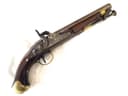 | Rare English percussion pistol signed Blake & Co. Birmingham (England) A superb percussion belt pistol, of English manufacture, signed BLAKE & Co., a gunsmithing firm active in Birmingham in the mid-19th century. This piece perfectly illustrates the British tradition of the civilian self-defense weapon, combining functionality, simplicity, and quality of workmanship. Designed for discreet carry while traveling, this pistol features a robust and well-made construction, characteristic of Birmingham production during the Victorian era. • System: percussion, single shot • Manufacturer: Blake & Co. (England) • Period: c. 1840–1860 • Barrel: smoothbore, octagonal at the breech then round, with original patina • Lock: English side lock, signed BLAKE & Co. • Stock: antique walnut, beautiful natural patina • Furniture: brass (trigger guard, butt plate, muzzle cap) • Equipment: loading rod under the barrel • Original use: civilian travel weapon / personal self-defense Condition: Very good condition for a mid-19th-century firearm. • Authentic and even patina • Sound wood, without structural cracks • High-quality wood/metal fitting • Mechanism in good apparent condition • No visible modern restorations Collector's Interest • Signed firearm, a highly sought-after characteristic • English manufacture from Birmingham, renowned for its quality • Excellent representation of British civilian percussion pistols • Ideal piece for a specialist collection, museum display case, or high-end historical decor Legal Status (Canada) • Antique percussion firearm, manufactured before 1898 • Classified as non-restricted under current Canadian legislation https://www.expoantique.net/en/product-page/rare-pistolet-anglais-à-percussion-signé-blake-co-birmingham-angleterre-ve | $1590 | Aug 4, 2026 |
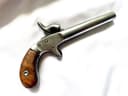 | Authentic small percussion pistol for personal defense, circa 1850–1880 A small, single-shot pistol with a percussion mechanism. The weapon features a rounded wooden grip screwed onto a metal stock. The barrel is straight and cylindrical in cross-section. The hammer, massive and curved, is external and operates a nipple designed to receive a priming cap. Historical context The percussion pistol represents a major evolution in 19th-century firearms. Replacing flintlock systems, this more reliable mechanism was widely used between 1820 and 1880. Compact models were popular for personal defense and discreet carry. Liège region (Belgium) Constituent elements • Barrel: steel, smoothbore, medium length • Plate/frame: steel, compact shape • Dog: external, forged steel • Trigger: integrated into the frame • Handle: wood (probably walnut), ergonomic Manufacturing techniques • Percussion mechanism (capsule) • Machined and fitted metal parts • Assembly using metal screws Dimensions • Total length: ~15 cm Markings and inscriptions • No visible markings • No apparent hallmarks or manufacturer's signature Satisfactory state of preservation • Metal: uniform patina, signs of wear and slight oxidation • Wood: small crack at the handle indicating normal wear and tear of over 100 years • Structure: complete Function and use • Personal defense weapon • Civilian use (personal protection, travel) • Single-shot firing with manual reloading using black powder and ball Origin and attribution • Probable origin: North America • Possible production centers: • Liège region (Belgium) https://www.expoantique.net/en/product-page/authentique-petit-pistolet-à-percussion-de-défense-personnelle-circa-1850-1880 | $340 | Aug 4, 2026 |